

CUET UG 2027: Preparation Plan, Subject Selection & University Guide
Mr. Prajwal Chaudhary
Head, Training & Placement, Haridwar University
Preparing for CUET UG 2027 involves far more than simply completing an entrance syllabus and attempting random mock tests. To secure admission into a top undergraduate programme, students must first define their intended academic direction, identify the exact CUET domain subjects required by target universities, and confirm that their Class 12 background satisfies institutional eligibility.
I would begin with the course, not the question paper. A student who plans to study economics, computer science, commerce or a language programme may face different subject requirements across universities. Choosing exam subjects without checking these requirements can restrict admission options later.
The National Testing Agency (NTA) publishes examination information through the official CUET UG website. Students should use official notifications and university admission documents to verify the 2027 rules, rather than relying on older preparation guides or unconfirmed reports about changes to the examination.
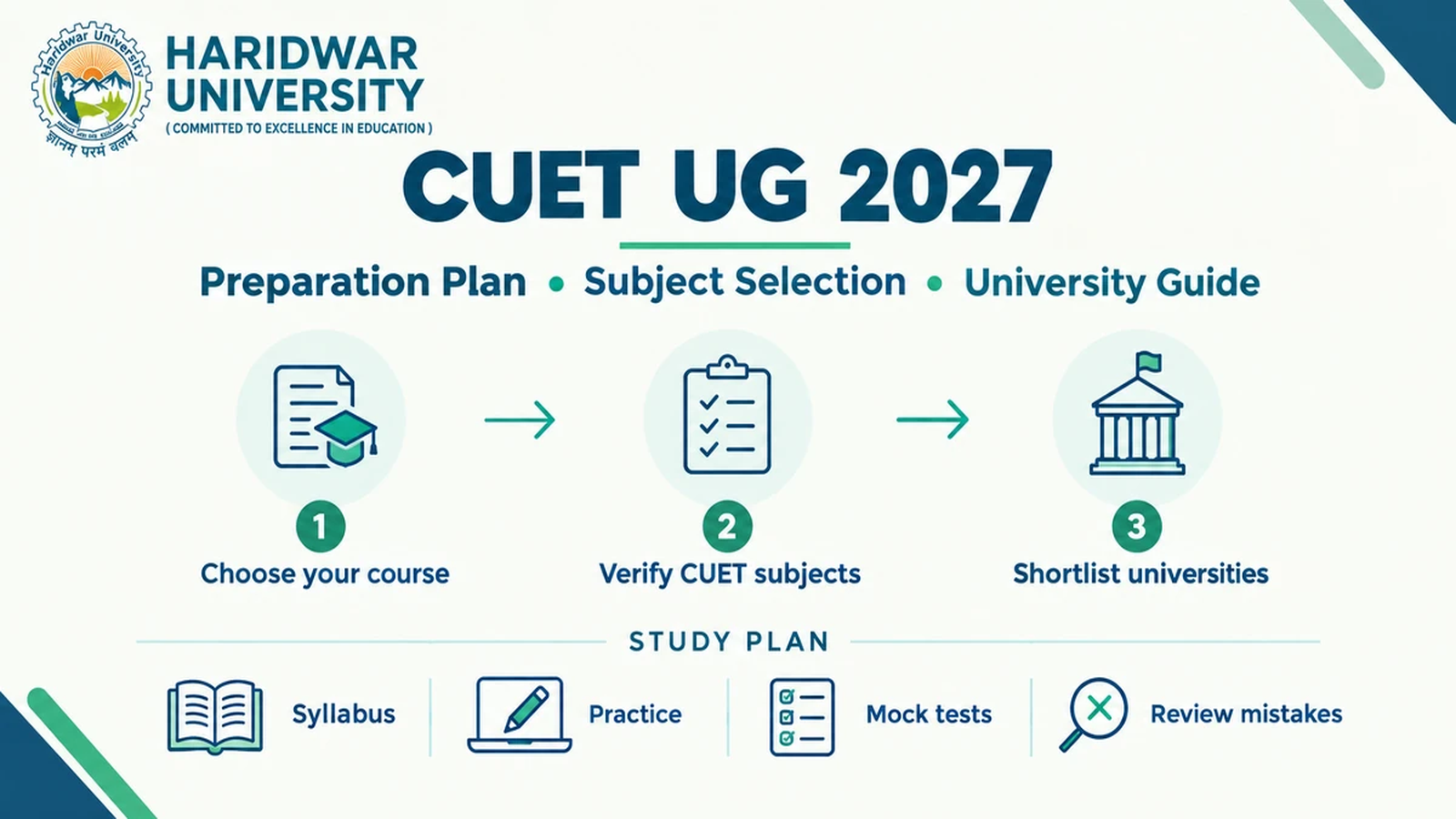
Here is the approach I recommend: choose the course, verify the subjects, plan preparation and then compare universities.
Table of Contents
- 1. What Students Should Know About CUET UG 2027
- 2. How to Choose CUET UG Subjects Based on Your Target Course
- 3. How to Shortlist Universities and Undergraduate Programmes
- 4. How to Prepare for CUET UG 2027 With a Practical Study Plan
- 5. How to Use Mock Tests and Track Your Progress
- 6. How to Manage CUET UG Applications and Admission Deadlines
- 7. Common CUET UG Preparation and University-Selection Mistakes
- 8. Your CUET UG 2027 Action Plan
- 9. Frequently Asked Questions (FAQs)
- 10. Make Every Preparation Decision Count
1. What Students Should Know About CUET UG 2027
The Common University Entrance Test (CUET UG) serves as the primary national gateway for undergraduate admissions across participating central, state, deemed, and private universities in India. However, sitting for CUET does not automatically grant admission eligibility for every degree an institution offers. Each university retains full autonomy to establish programme-specific subject prerequisites, minimum qualifying marks in Class 12, and internal counselling procedures.
For the 2027 cycle, aspirants must systematically verify six critical checkpoints as official notifications are published:
Speculative reports regarding changes to CUET UG 2027 should not be treated as binding until the official information bulletin is released by the NTA. Students can confidently begin mastering core NCERT concepts today, while refraining from purchasing untested private guides or prematurely restricting subject choices.
2. How to Choose CUET UG Subjects Based on Your Target Course
Subject selection is the single most pivotal strategic decision in CUET planning. Choosing papers solely based on personal interest or perceived ease can unintentionally disqualify you from your desired course.
I recommend following this sequence:
- Identify Two or Three Target Programmes: Define specific degrees—such as B.Tech Computer Science, B.Com (Hons), B.Pharm, BBA, or B.Sc Agriculture.
- Map Universities Offering Those Courses: Start with the official CUET participating-universities list.
- Review Programme-Specific Admission Mandates: Determine exactly which domain papers, language exams, or General Test components each institution specifies for that specific degree.
- Find the Common Subject Denominator: Select an integrated combination of papers that fulfills eligibility criteria across multiple shortlisted institutions simultaneously.
- Finalize Choices via Official Bulletins: Double-check subject rules in the latest university admission notifications before submitting your final registration.
Consider a student interested in both economics and business-related degrees. Rather than assuming the same CUET subjects will work for every course, the student should compare the requirements published by each target university. If the accepted combinations differ, that difference should inform the shortlist before the application is submitted.
This is also where students should distinguish examination eligibility from admission eligibility. Meeting the conditions to sit a paper does not necessarily satisfy the requirements for a particular undergraduate programme.
3. How to Shortlist Universities and Undergraduate Programmes
A realistic university shortlist should balance academic ambition with verifiable quality, practical affordability, and career outcomes, rather than superficial social media rankings.
Create a shortlist of around five to eight suitable programmes as a working target, adjusting it to your circumstances and application budget. For each option, save the official programme page, subject requirements, fees and deadline in one spreadsheet.
Do not assume that every university uses CUET scores in the same way. A participating institution may have its own eligibility conditions, merit calculation, counselling procedure or additional application requirements. Verify the details for each programme independently.
Students exploring undergraduate options at Haridwar University can review the HU academic programmes and fees and scholarship information. These pages can help with programme and cost research; students should confirm the admission route and current requirements for their intended course directly with the university.
4. How to Prepare for CUET UG 2027 With a Practical Study Plan
An effective CUET UG 2027 preparation strategy aligns syllabus coverage with regular diagnostic reviews. Rather than following rigid, unsustainable 14-hour study tables, divide your timeline into three progressive stages:
Stage 1: Build the Foundation (NCERT Mastery)
Carefully examine the official syllabus for each selected domain paper. Benchmark topics against your Class 12 textbooks. Clarify foundational principles before progressing to advanced problem solving. Avoid collecting too many competing reference guides; disciplined study of standard NCERT texts yields the highest return on time.
Stage 2: Practice Topic by Topic (Error Log Tracking)
Immediately after finishing a chapter, solve 30 to 50 topic-level multiple-choice questions. Maintain an explicit Error Log categorizing every incorrect answer: conceptual gap, calculation slip, or question misinterpretation. Periodically revisiting this error log prevents repeating identical mistakes under test conditions.
Stage 3: Practice Under Timed Conditions (Full-Length Mocks)
During the final 10 to 12 weeks leading up to the examination, transition to timed sectional tests and comprehensive full-length simulation mocks. Train yourself to manage clock pressure, select easier questions first, and avoid negative marking penalties on ambiguous items.
A flexible weekly routine might look like this:
These percentages are a planning example, not an official CUET formula. Students who are still learning core concepts may need more revision time, while those nearing the exam may need more timed practice.
If board examinations are also approaching, coordinate revision where the syllabuses overlap. Do not assume that the board syllabus and CUET requirements are identical; compare the official documents before deciding what can be revised together, review our exam preparation and study planning guide.
5. How to Use Mock Tests and Track Your Progress
Mock tests provide genuine value only when their outcomes directly reshape your study actions. Merely looking at a raw numerical score fails to reveal whether difficulties stem from deficient subject comprehension, careless reading, or flawed time allocation.
Following every mock examination, document five essential metrics:
- Attempt vs. Accuracy Ratio: Total attempted questions compared against correct responses.
- Subject/Topic Accuracy Percentages: Isolating specific chapters exhibiting sub-70% accuracy.
- Time-Induced Unattempted Items: Questions left unattempted strictly due to poor time pacing.
- Avoidable Negative Marks: Marks lost to rushed reading or ill-advised 50-50 guesses.
- Actionable Remedial Targets: Two specific sub-topics to re-study prior to the next mock.
Avoid interpreting a raw mock-test score as a guaranteed university admission outcome. The meaning of a score depends on the examination's applicable scoring rules, the programme, the university's selection process and the applicant pool. Previous-year cut-offs, where officially published, can provide context but cannot guarantee a future result.
6. How to Manage CUET UG Applications and Admission Deadlines
Preparation and application management should run alongside each other. A strong score cannot compensate for a missed application deadline or an unmet programme eligibility condition.
Maintain a calendar with separate entries for:
- NTA notification and registration announcements.
- Application submission and correction windows, if announced.
- Examination dates and admit-card updates.
- Individual university application deadlines.
- Counselling, document verification and fee-payment deadlines.
Check the official CUET UG portal for examination announcements and consult each university's own admissions website for its application and counselling process. Do not assume that registering for CUET automatically completes every university application.
Keep digital copies of the documents required by the official instructions. Before submitting a form, check the selected papers, personal details, category information where applicable and payment confirmation. Save the final application and receipt for future reference.
7. Common CUET UG Preparation and University-Selection Mistakes
Several avoidable errors can complicate the process:
- Choosing subjects before courses: This can leave students with combinations that do not satisfy their target programme requirements.
- Using old information without checking dates: Previous-year syllabus documents, cut-offs and application dates may not apply to 2027.
- Confusing participation with eligibility: A university's participation in CUET does not mean every course accepts every subject combination.
- Preparing without reviewing mistakes: Repeated practice offers limited value when students do not address the reasons for incorrect answers.
- Shortlisting universities by reputation alone: Fees, eligibility, course structure, location and admission procedures also matter.
- Trusting unconfirmed exam changes: Proposed reforms should not be treated as final instructions until official confirmation.
The solution is straightforward: verify, record and review. A small spreadsheet of official requirements is often more useful than a long list of unverified college recommendations.
8. Your CUET UG 2027 Action Plan
Before moving into intensive preparation, complete these steps:
- Identify your preferred undergraduate courses and specialisations.
- Shortlist universities that offer those programmes.
- Verify the required CUET subjects and Class 12 eligibility for each course.
- Download the latest official syllabus and examination information when published.
- Prepare a weekly study timetable with time for revision, practice and mock-test analysis.
- Track NTA announcements and individual university application deadlines separately.
- Recheck all subject choices and eligibility conditions before submitting your application.
Students who are still deciding on their undergraduate direction can begin by exploring Haridwar University's academic programmes. For broader study-planning ideas, our semester examination preparation guide also discusses revision planning and tracking progress.
9. Frequently Asked Questions (FAQs)
When should I start preparing for CUET UG 2027?
Start by reviewing your intended courses, subject requirements, and the official syllabus. Beginning early provides adequate time to strengthen concepts, practise questions, and rectify weak areas alongside your Class 12 board preparations.
Can I prepare for CUET UG 2027 in one month?
A single month can be utilized effectively for focused revision and timed practice if you have already mastered the Class 12 curriculum. Begin with a diagnostic test, prioritize weaker syllabus topics, and review error logs thoroughly after every mock session.
How do I choose the right CUET UG subjects?
First identify your preferred degree programmes. Next, check the subject combinations and Class 12 eligibility conditions mandated by each target university. Never choose papers solely because they seem easy or because older preparation guides recommended them.
How do I choose a university through CUET UG?
Compare eligible programmes using course content, subject requirements, total cost, location, facilities and admission procedures. Check official university pages and confirm whether a separate application or counselling registration is required. A university shortlist should reflect your academic interests and practical circumstances, not rankings alone.
Is a score of 700 good in CUET UG?
A score cannot be judged reliably without knowing the applicable examination's scoring framework, the target programme and the university's admission process. The total possible score depends on the number of subjects attempted and the applicable scoring rules. Compare your performance with relevant, officially published admission information where available. Previous-year cut-offs can provide context, but they do not guarantee admission in 2027.
Where can I find the official CUET UG 2027 syllabus and exam dates?
Check the official CUET UG website for the latest information bulletin, syllabus, registration announcements and examination updates. If a particular 2027 detail has not been officially announced, treat dates or pattern changes reported elsewhere as provisional.
Will the CUET UG 2027 exam pattern change?
Changes should be treated as confirmed only when the National Testing Agency publishes the relevant official information. News reports may describe proposals under consideration, but students should not assume that proposed subject limits, paper durations or examination arrangements will become final. Check the official notice before changing your preparation plan.
10. Make Every Preparation Decision Count
CUET UG 2027 preparation is more effective when students make informed decisions before investing months in revision. Start with the undergraduate course you want, verify its subject requirements, build a realistic preparation plan and compare universities using reliable admission information.
The objective is not simply to complete the syllabus. It is to arrive at the examination with the right preparation and a shortlist of programmes for which you have checked the eligibility conditions.
Plan your subjects carefully, practise consistently and verify every important admission detail through official sources.
Shape Your Undergraduate Future at Haridwar University
Haridwar University offers career-oriented undergraduate degrees across Engineering & Technology, Computer Applications, Pharmacy, Management & Commerce, Agriculture, and Health Sciences with world-class faculty, modern laboratories, and dedicated placement support.